
 Image 1 of 1
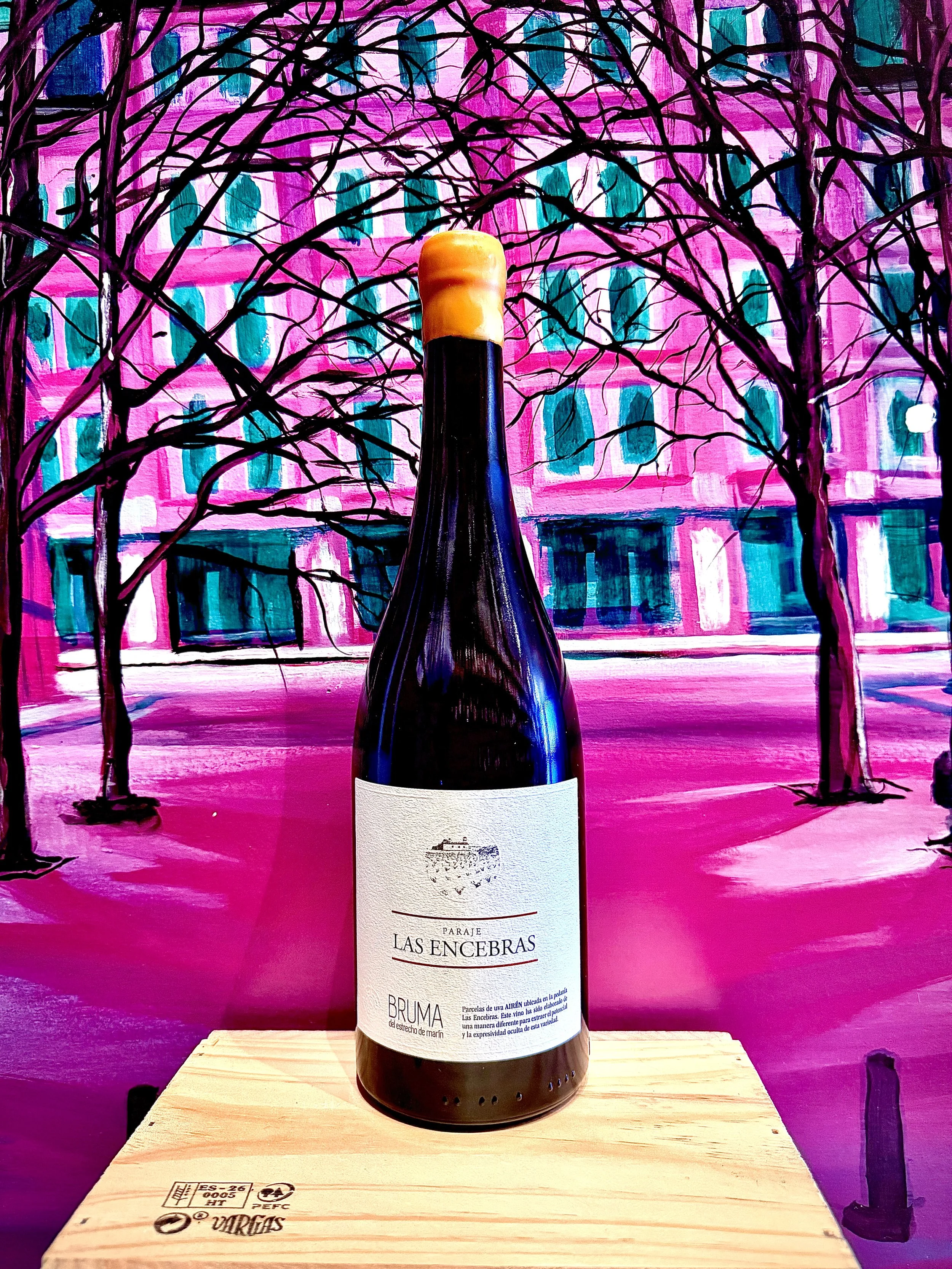
Bruma del Estrecho 'Paraje Las Encebras'
Bruma del Estrecho 'Paraje Las Encebras'
Grapes — 100% Airén
Region — Jumilla DO, Murcia, Spain
Tasting Notes — Deep gold with an amber glow. The nose is immediate and arresting — warm honey, dried apricot, toasted almonds, and a saline mineral edge, with a whisper of chamomile and oxidative complexity from the biological aging. The palate is rich and textured yet surprisingly fresh, with a nutty depth and a long, dry finish that lingers with warmth and quiet intensity. This is a wine that rewards slow attention. Pour it, walk away, come back, and find something new.
The Wine — A skin-contact orange wine made from 100% Airén — a variety currently on the verge of extinction in Jumilla, where only a handful of old vineyards survive. The Las Encebras vines, planted between 1980 and 1985, sit at 380–400 meters elevation on sandy surface soils over deep clay-limestone subsoil, receiving just 179mm of rainfall in 2024. The sandy soils add a touch of freshness to an otherwise warm, concentrated fruit — and the old vines produce tiny quantities of intensely healthy grapes. Just 1,077 bottles were made from the 2024 vintage.
Farming — Traditional dryland farming (secano), no irrigation, low planting density of 1,400–1,600 vines per hectare — a deliberate choice to let each vine produce a small, concentrated crop without competition. Old vine management, entirely by hand. Airén's long vegetative cycle makes it uniquely suited to withstand the heat and scarce rainfall of southern Jumilla — which is precisely why Elena Pacheco is determined to save it.
Winemaking — Hand harvested in the second week of September. Whole destemmed grapes fermented in 1,500-liter stainless steel tanks with 20% whole cluster included on top, nine days of skin maceration with native yeasts. After pressing, fermentation is completed in stainless steel — then comes the step that makes this wine singular: five months of biological aging in 20-liter glass demijohns under a veil of flor yeast, the same protective layer of indigenous yeast used in the production of fino Sherry. This "crianza biológica" prevents oxidation while building extraordinary aromatic complexity and textural depth — a winemaking tradition of the south of Spain, applied here to rescue Airén from obscurity.
The Producer — Elena Pacheco is the third generation of her family to make wine at Viña Elena on the Estrecho de Marín in Jumilla. Born in Jumilla in 1973, she studied economics before dedicating herself fully to wine — earning a masters in viticulture, oenology, and wine marketing and transforming the family estate from a bulk wine operation into one of the most interesting artisan projects in southeastern Spain. The Bruma del Estrecho range was born from her collaboration with Isio Ramos, a wine distributor and educator who shares her vision of making honest, unmaquillaged wines that speak precisely of where they come from. Paraje Las Encebras is their most radical expression: a love letter to a grape variety that nobody wanted, from a corner of Spain that most people overlook, made in a way that has no modern reference point. It is, in the best possible sense, completely its own thing.
Drink It With — Aged sheep's milk cheese, jamón ibérico, roasted almonds, salt cod, miso-glazed fish, or any occasion that calls for a wine with depth, history, and a story worth telling.
Bruma del Estrecho 'Paraje Las Encebras'
Grapes — 100% Airén
Region — Jumilla DO, Murcia, Spain
Tasting Notes — Deep gold with an amber glow. The nose is immediate and arresting — warm honey, dried apricot, toasted almonds, and a saline mineral edge, with a whisper of chamomile and oxidative complexity from the biological aging. The palate is rich and textured yet surprisingly fresh, with a nutty depth and a long, dry finish that lingers with warmth and quiet intensity. This is a wine that rewards slow attention. Pour it, walk away, come back, and find something new.
The Wine — A skin-contact orange wine made from 100% Airén — a variety currently on the verge of extinction in Jumilla, where only a handful of old vineyards survive. The Las Encebras vines, planted between 1980 and 1985, sit at 380–400 meters elevation on sandy surface soils over deep clay-limestone subsoil, receiving just 179mm of rainfall in 2024. The sandy soils add a touch of freshness to an otherwise warm, concentrated fruit — and the old vines produce tiny quantities of intensely healthy grapes. Just 1,077 bottles were made from the 2024 vintage.
Farming — Traditional dryland farming (secano), no irrigation, low planting density of 1,400–1,600 vines per hectare — a deliberate choice to let each vine produce a small, concentrated crop without competition. Old vine management, entirely by hand. Airén's long vegetative cycle makes it uniquely suited to withstand the heat and scarce rainfall of southern Jumilla — which is precisely why Elena Pacheco is determined to save it.
Winemaking — Hand harvested in the second week of September. Whole destemmed grapes fermented in 1,500-liter stainless steel tanks with 20% whole cluster included on top, nine days of skin maceration with native yeasts. After pressing, fermentation is completed in stainless steel — then comes the step that makes this wine singular: five months of biological aging in 20-liter glass demijohns under a veil of flor yeast, the same protective layer of indigenous yeast used in the production of fino Sherry. This "crianza biológica" prevents oxidation while building extraordinary aromatic complexity and textural depth — a winemaking tradition of the south of Spain, applied here to rescue Airén from obscurity.
The Producer — Elena Pacheco is the third generation of her family to make wine at Viña Elena on the Estrecho de Marín in Jumilla. Born in Jumilla in 1973, she studied economics before dedicating herself fully to wine — earning a masters in viticulture, oenology, and wine marketing and transforming the family estate from a bulk wine operation into one of the most interesting artisan projects in southeastern Spain. The Bruma del Estrecho range was born from her collaboration with Isio Ramos, a wine distributor and educator who shares her vision of making honest, unmaquillaged wines that speak precisely of where they come from. Paraje Las Encebras is their most radical expression: a love letter to a grape variety that nobody wanted, from a corner of Spain that most people overlook, made in a way that has no modern reference point. It is, in the best possible sense, completely its own thing.
Drink It With — Aged sheep's milk cheese, jamón ibérico, roasted almonds, salt cod, miso-glazed fish, or any occasion that calls for a wine with depth, history, and a story worth telling.