
 Image 1 of 1
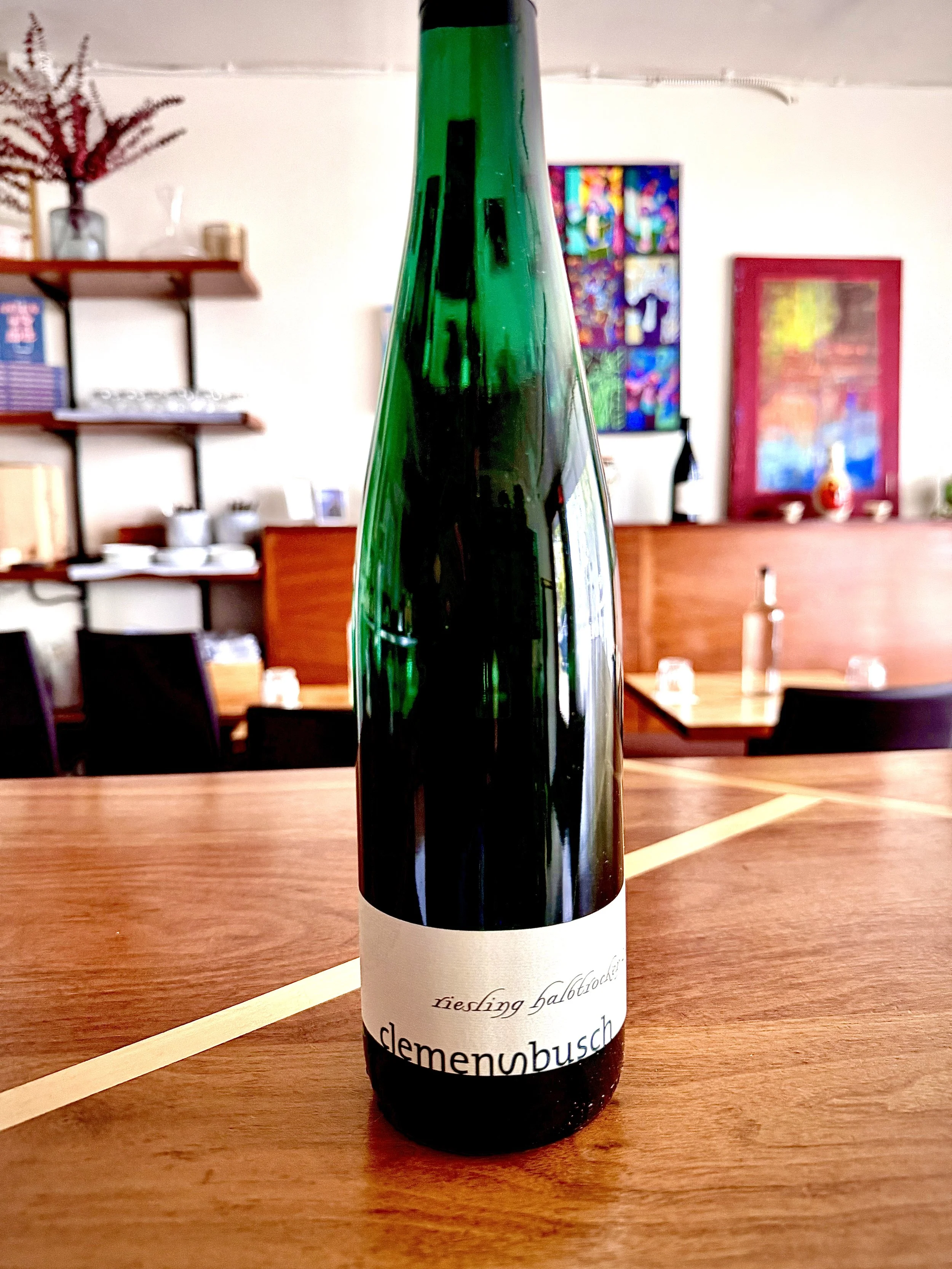
Clemens Busch Riesling Halbtrocken
Clemens Busch Riesling Halbtrocken
Grapes — 100% Riesling
Region — Pünderich, Terrassenmosel, Mosel, Germany
Tasting Notes — Pale straw with a green-gold shimmer. Cool and delicately floral on the nose, with candied yellow fruit, almond, fresh herbs, ginger, and the wet-stone signature that slate soils leave on everything grown in them. The palate is lively and precise, with the small amount of residual sugar sitting in tension against bracing Mosel acidity rather than softening it. Low in alcohol, high in energy, and finishing long on tart minerals and citrus. Intense without ever being heavy.
The Wine — Riesling from the Pündericher Marienburg, a 25 hectare hill facing south and southeast directly onto the Mosel, widely considered among the very finest sites in the region. Seventeen hectares of that hill are planted, and Clemens Busch owns eleven of them. He acquired much of it in the 1980s as neighbors abandoned these punishing steep slopes to plant Pinot Noir on the flats, where machines could do the work. The Marienburg is unusual in that its slate changes color across the hill: blue, grey, and red, each producing measurably different wine. Clemens vinifies them separately, and the Halbtrocken draws on the estate's broader holdings to make something more immediately generous than his single-parcel bottlings. The off-dry style is deliberate: a little sugar, a lot of acid, and remarkably low alcohol.
Farming — Organic since 1984, biodynamic since 2005, and Demeter certified since 2015, with the estate also farming to respekt-BIODYN guidelines. Clemens and Rita were among the very first biodynamic producers on the Mosel and remain among its most respected. Cover crops between the rows, fertilization limited to natural nitrogen, clay minerals, and plant extracts, and a focus on strengthening the vines themselves rather than treating problems after the fact. The old vines have proven to be their best defense against a changing climate: deep roots, Clemens notes, care far less about too much rain or too little.
Winemaking — Grapes lightly crushed and pressed at low pressure. Spontaneous fermentation with the vineyard's own yeasts, with cultured yeast used only in exceptional circumstances for Trockenbeerenauslese. Roughly 80% of the estate's wine ferments and ages in 1,000 liter Fuder, ancient oak casks whose youngest is around 57 years old and many of which were built by Rita's father; the fine pores of that old wood let the wine breathe as it matures. The balance goes to stainless steel. At least ten months on full lees. Nothing is ever added to the wine, and the wines are never fined. A low dose of sulfur at bottling.
The Producer — Clemens Busch started working in the family cellar in 1974 at the age of seventeen, at a time when Mosel winemaking was still passed from father to son and formal study in viticulture was essentially unheard of. He took over the estate in 1984 and is the fifth generation to run it. Every one of his predecessors was also named Clemens; ever the iconoclast, he named his own sons Florian and Johannes. Together with Rita, he converted immediately to organics and later to biodynamics, decades before either was fashionable in Germany, and built the estate into one of the benchmark addresses of the Mosel. The family home on the riverbank dates to 1663 and looks directly across at the Marienburg. Johannes has since taken over the estate; Florian went south and founded Domaine Flo Busch in the Languedoc, which also sits on our shelf. Clemens is obsessively devoted to a single grape and a single hill, and the wines are as transparent an expression of steep-slope slate as exists anywhere in the world.
Drink It With — Pork with apples, roast duck, Thai and Vietnamese food, anything with chilli heat, smoked fish, washed rind cheeses, or a spread of charcuterie on a warm afternoon.
Clemens Busch Riesling Halbtrocken
Grapes — 100% Riesling
Region — Pünderich, Terrassenmosel, Mosel, Germany
Tasting Notes — Pale straw with a green-gold shimmer. Cool and delicately floral on the nose, with candied yellow fruit, almond, fresh herbs, ginger, and the wet-stone signature that slate soils leave on everything grown in them. The palate is lively and precise, with the small amount of residual sugar sitting in tension against bracing Mosel acidity rather than softening it. Low in alcohol, high in energy, and finishing long on tart minerals and citrus. Intense without ever being heavy.
The Wine — Riesling from the Pündericher Marienburg, a 25 hectare hill facing south and southeast directly onto the Mosel, widely considered among the very finest sites in the region. Seventeen hectares of that hill are planted, and Clemens Busch owns eleven of them. He acquired much of it in the 1980s as neighbors abandoned these punishing steep slopes to plant Pinot Noir on the flats, where machines could do the work. The Marienburg is unusual in that its slate changes color across the hill: blue, grey, and red, each producing measurably different wine. Clemens vinifies them separately, and the Halbtrocken draws on the estate's broader holdings to make something more immediately generous than his single-parcel bottlings. The off-dry style is deliberate: a little sugar, a lot of acid, and remarkably low alcohol.
Farming — Organic since 1984, biodynamic since 2005, and Demeter certified since 2015, with the estate also farming to respekt-BIODYN guidelines. Clemens and Rita were among the very first biodynamic producers on the Mosel and remain among its most respected. Cover crops between the rows, fertilization limited to natural nitrogen, clay minerals, and plant extracts, and a focus on strengthening the vines themselves rather than treating problems after the fact. The old vines have proven to be their best defense against a changing climate: deep roots, Clemens notes, care far less about too much rain or too little.
Winemaking — Grapes lightly crushed and pressed at low pressure. Spontaneous fermentation with the vineyard's own yeasts, with cultured yeast used only in exceptional circumstances for Trockenbeerenauslese. Roughly 80% of the estate's wine ferments and ages in 1,000 liter Fuder, ancient oak casks whose youngest is around 57 years old and many of which were built by Rita's father; the fine pores of that old wood let the wine breathe as it matures. The balance goes to stainless steel. At least ten months on full lees. Nothing is ever added to the wine, and the wines are never fined. A low dose of sulfur at bottling.
The Producer — Clemens Busch started working in the family cellar in 1974 at the age of seventeen, at a time when Mosel winemaking was still passed from father to son and formal study in viticulture was essentially unheard of. He took over the estate in 1984 and is the fifth generation to run it. Every one of his predecessors was also named Clemens; ever the iconoclast, he named his own sons Florian and Johannes. Together with Rita, he converted immediately to organics and later to biodynamics, decades before either was fashionable in Germany, and built the estate into one of the benchmark addresses of the Mosel. The family home on the riverbank dates to 1663 and looks directly across at the Marienburg. Johannes has since taken over the estate; Florian went south and founded Domaine Flo Busch in the Languedoc, which also sits on our shelf. Clemens is obsessively devoted to a single grape and a single hill, and the wines are as transparent an expression of steep-slope slate as exists anywhere in the world.
Drink It With — Pork with apples, roast duck, Thai and Vietnamese food, anything with chilli heat, smoked fish, washed rind cheeses, or a spread of charcuterie on a warm afternoon.