
 Image 1 of 1
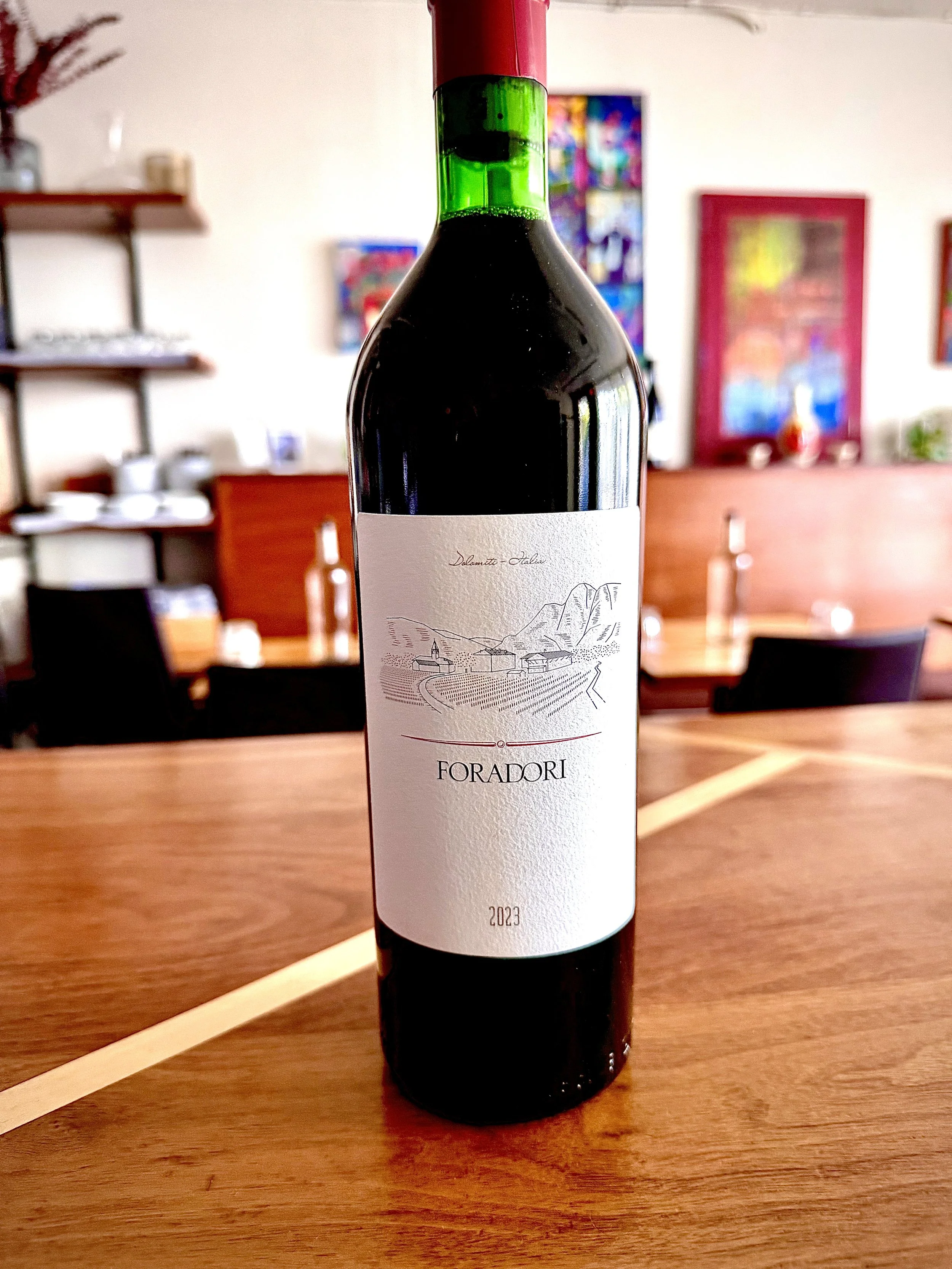
Foradori Teroldego, Vigneti delle Dolomiti IGT
Foradori Teroldego, Vigneti delle Dolomiti IGT
Grapes — 100% Teroldego
Region — Campo Rotaliano, Trentino, Italy
Tasting Notes — Deep, saturated ruby-purple. Fresh dark cherry and wild berry on the nose, lifted by violets and threaded with cocoa, alpine herbs, and warm spice. The palate is dense and deeply flavorful but never heavy, carried by the vivid acidity that high altitude gives and finishing on a stony, mineral note that pulls the whole thing tight. Structured, alive, and unmistakably alpine.
The Wine — The estate's core red, and the wine the family simply calls "Foradori." First bottled by Elisabetta's parents in 1960 and still the largest production at the estate. The fruit comes from nine hectares of vines planted between 1956 and 2005 on the Campo Rotaliano, a flat, sunny, well-drained plateau ringed by the peaks of the Dolomites. The soils are alluvial sand and gravel over Dolomitic limestone. Older vines are trained in the traditional pergola trentina, younger vines on guyot wires. There are fifteen separate parcels, all hand-harvested and vinified individually before blending.
Campo Rotaliano is a genuine climatic paradox: one of the warmest places in all of Italy in high summer, yet constantly cooled by alpine breezes off the mountains. That tension between concentration and freshness is what makes Teroldego from here taste like nowhere else.
Farming — Certified biodynamic since 2002, long before natural wine became fashionable, across the whole 28 hectare estate between the Colognola hills and the Campo Rotaliano plains. Elisabetta's most significant contribution to the region may be her work with massale selection: through decades of patient observation she has identified and mapped fifteen distinct biotypes of Teroldego, rebuilding genetic diversity in a grape that had been flattened by industrial clonal selection.
Winemaking — Bunches are partly destemmed and partly left whole, depending on the vintage. Uncrushed berries and whole clusters are layered into cement tanks where they ferment spontaneously with indigenous yeasts and no sulfur added. All winemaking manipulation is banned at the estate, as are fining and filtration. Minimal sulfur, if any, at bottling.
The Producer — Elisabetta Foradori took over her family's estate in 1984 at the age of twenty-one, after the sudden death of her father, and by her own account she did it more out of duty than passion. The passion came later, through the work itself. By the 1990s she was celebrated across Italy as the queen of Teroldego, and by 2000 she had lost her connection to the work entirely. What followed was a long period of questioning and experiment that led her to biodynamics, to massale selection, and to amphorae, and away from any interest in what the wine industry wanted from her. She was among the first Italian vignerons to work seriously with clay vessels, and she is now considered by most people who think about these things to be the most important biodynamic producer in the country.
Teroldego is often called the Prince of Trentino, but before Elisabetta it was mostly a high-yield workhorse grape in a region that had largely given itself over to international varieties and market-driven wines. She gave it back its dignity. This bottle, the most affordable in her range, is the clearest and most joyful statement of what that means.
Drink It With — Braised beef, venison, mushroom risotto, speck and aged alpine cheese, wood-fired pizza, or polenta with anything rich spooned over it.
Foradori Teroldego, Vigneti delle Dolomiti IGT
Grapes — 100% Teroldego
Region — Campo Rotaliano, Trentino, Italy
Tasting Notes — Deep, saturated ruby-purple. Fresh dark cherry and wild berry on the nose, lifted by violets and threaded with cocoa, alpine herbs, and warm spice. The palate is dense and deeply flavorful but never heavy, carried by the vivid acidity that high altitude gives and finishing on a stony, mineral note that pulls the whole thing tight. Structured, alive, and unmistakably alpine.
The Wine — The estate's core red, and the wine the family simply calls "Foradori." First bottled by Elisabetta's parents in 1960 and still the largest production at the estate. The fruit comes from nine hectares of vines planted between 1956 and 2005 on the Campo Rotaliano, a flat, sunny, well-drained plateau ringed by the peaks of the Dolomites. The soils are alluvial sand and gravel over Dolomitic limestone. Older vines are trained in the traditional pergola trentina, younger vines on guyot wires. There are fifteen separate parcels, all hand-harvested and vinified individually before blending.
Campo Rotaliano is a genuine climatic paradox: one of the warmest places in all of Italy in high summer, yet constantly cooled by alpine breezes off the mountains. That tension between concentration and freshness is what makes Teroldego from here taste like nowhere else.
Farming — Certified biodynamic since 2002, long before natural wine became fashionable, across the whole 28 hectare estate between the Colognola hills and the Campo Rotaliano plains. Elisabetta's most significant contribution to the region may be her work with massale selection: through decades of patient observation she has identified and mapped fifteen distinct biotypes of Teroldego, rebuilding genetic diversity in a grape that had been flattened by industrial clonal selection.
Winemaking — Bunches are partly destemmed and partly left whole, depending on the vintage. Uncrushed berries and whole clusters are layered into cement tanks where they ferment spontaneously with indigenous yeasts and no sulfur added. All winemaking manipulation is banned at the estate, as are fining and filtration. Minimal sulfur, if any, at bottling.
The Producer — Elisabetta Foradori took over her family's estate in 1984 at the age of twenty-one, after the sudden death of her father, and by her own account she did it more out of duty than passion. The passion came later, through the work itself. By the 1990s she was celebrated across Italy as the queen of Teroldego, and by 2000 she had lost her connection to the work entirely. What followed was a long period of questioning and experiment that led her to biodynamics, to massale selection, and to amphorae, and away from any interest in what the wine industry wanted from her. She was among the first Italian vignerons to work seriously with clay vessels, and she is now considered by most people who think about these things to be the most important biodynamic producer in the country.
Teroldego is often called the Prince of Trentino, but before Elisabetta it was mostly a high-yield workhorse grape in a region that had largely given itself over to international varieties and market-driven wines. She gave it back its dignity. This bottle, the most affordable in her range, is the clearest and most joyful statement of what that means.
Drink It With — Braised beef, venison, mushroom risotto, speck and aged alpine cheese, wood-fired pizza, or polenta with anything rich spooned over it.