
 Image 1 of 1
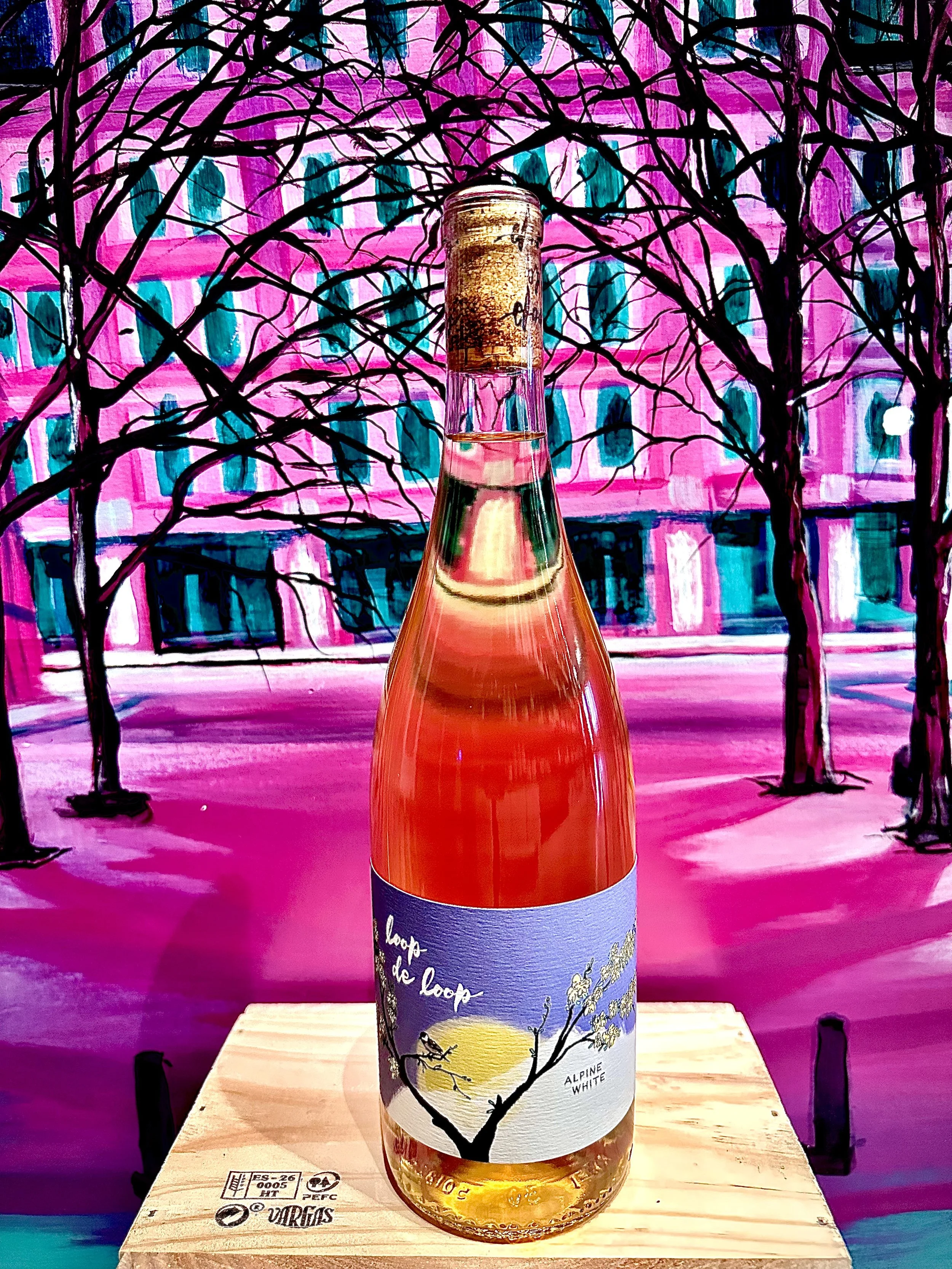
Loop de Loop Alpine White
Loop de Loop Alpine White
Grapes — Grüner Veltliner, Riesling, Chardonnay
Region — Underwood Mountain, Columbia Gorge AVA, Washington/Oregon
Tasting Notes — Pale gold with a luminous clarity and a delicate aromatic lift that arrives before you've even raised the glass. Lemon meringue, white pepper, citrus blossom, pear, and fresh herbs on the nose — bright, ethereal, and unmistakably alpine in character. The palate is light and precise, with crashing acidity that cools the palate before giving way to stone fruit and a lovely texture from lees aging. A whisper of salinity on the finish pulls everything into sharp, clean focus. This is white wine that feels like elevation.
The Wine — A blend of the three varieties that thrive on Underwood Mountain's volcanic, wind-swept slopes — Grüner Veltliner, Riesling, and Chardonnay — grown at 1,200 to 1,500 feet elevation where the comparison to alpine wine regions is not metaphorical. The site sits alongside Mt. Hood, and at this altitude, with volcanic ashy sandy loam soil and winds gusting up to 60 mph off the Columbia River, the vines produce wines of striking minerality and bright acidity — more Alsatian than Oregonian, more mountain than valley. All grapes are dry farmed and no-till. Fermented dry with wild yeasts, aged on lees for added texture and a hint of salinity, bottled by hand.
Farming — Regenerative-organically farmed across all estate and neighboring vineyard sources. Julia and Scott have planted over 500 native bare root shrubs and seeded wildflowers, grasses, and cover crops throughout the property. No synthetic pesticides, no herbicides, no irrigation on dry-farmed sites. Minimal soil disturbance to protect the mycorrhizal fungi and food web that Julia considers essential to the life and energy of the wines.
Winemaking — Wild yeasts from the fruit and vineyard — never inoculated. Fermented dry, aged on lees for texture and minerality, bottled unfined and unfiltered, entirely by hand. Less than 20ppm sulfur added, and nothing else. Julia's role in the cellar is, in her own words, that of a shepherd: she has no predetermined destination for each wine, and lets the fermentation find its own path.
The Producer — Loop de Loop was founded in 2012 by Julia Bailey Gulstine — a winemaker whose path wound through the Loire Valley and Italy, Argyle Winery and Patricia Green Cellars, an MA in international relations, and five years working with women in business in the occupied Palestinian Territories, where she made her first wine from a surprise delivery of grapes. She returned to Oregon and settled with her partner Scott Gulstine on a steep, volcanic hillside above the Columbia River — one of the most geographically extraordinary wine sites in the Pacific Northwest. Together they farm every acre, make every wine, and bottle every bottle themselves. The Alpine White is perhaps the most direct expression of their mountain: three cool-climate varieties raised side by side at altitude, fermented slowly in the cold, and released only when they are ready.
Drink It With — Wiener schnitzel, grilled asparagus, roast chicken with tarragon, spiced Thai noodles, mild soft cheese, or a long afternoon on an elevation with a view worth the climb.
Loop de Loop Alpine White
Grapes — Grüner Veltliner, Riesling, Chardonnay
Region — Underwood Mountain, Columbia Gorge AVA, Washington/Oregon
Tasting Notes — Pale gold with a luminous clarity and a delicate aromatic lift that arrives before you've even raised the glass. Lemon meringue, white pepper, citrus blossom, pear, and fresh herbs on the nose — bright, ethereal, and unmistakably alpine in character. The palate is light and precise, with crashing acidity that cools the palate before giving way to stone fruit and a lovely texture from lees aging. A whisper of salinity on the finish pulls everything into sharp, clean focus. This is white wine that feels like elevation.
The Wine — A blend of the three varieties that thrive on Underwood Mountain's volcanic, wind-swept slopes — Grüner Veltliner, Riesling, and Chardonnay — grown at 1,200 to 1,500 feet elevation where the comparison to alpine wine regions is not metaphorical. The site sits alongside Mt. Hood, and at this altitude, with volcanic ashy sandy loam soil and winds gusting up to 60 mph off the Columbia River, the vines produce wines of striking minerality and bright acidity — more Alsatian than Oregonian, more mountain than valley. All grapes are dry farmed and no-till. Fermented dry with wild yeasts, aged on lees for added texture and a hint of salinity, bottled by hand.
Farming — Regenerative-organically farmed across all estate and neighboring vineyard sources. Julia and Scott have planted over 500 native bare root shrubs and seeded wildflowers, grasses, and cover crops throughout the property. No synthetic pesticides, no herbicides, no irrigation on dry-farmed sites. Minimal soil disturbance to protect the mycorrhizal fungi and food web that Julia considers essential to the life and energy of the wines.
Winemaking — Wild yeasts from the fruit and vineyard — never inoculated. Fermented dry, aged on lees for texture and minerality, bottled unfined and unfiltered, entirely by hand. Less than 20ppm sulfur added, and nothing else. Julia's role in the cellar is, in her own words, that of a shepherd: she has no predetermined destination for each wine, and lets the fermentation find its own path.
The Producer — Loop de Loop was founded in 2012 by Julia Bailey Gulstine — a winemaker whose path wound through the Loire Valley and Italy, Argyle Winery and Patricia Green Cellars, an MA in international relations, and five years working with women in business in the occupied Palestinian Territories, where she made her first wine from a surprise delivery of grapes. She returned to Oregon and settled with her partner Scott Gulstine on a steep, volcanic hillside above the Columbia River — one of the most geographically extraordinary wine sites in the Pacific Northwest. Together they farm every acre, make every wine, and bottle every bottle themselves. The Alpine White is perhaps the most direct expression of their mountain: three cool-climate varieties raised side by side at altitude, fermented slowly in the cold, and released only when they are ready.
Drink It With — Wiener schnitzel, grilled asparagus, roast chicken with tarragon, spiced Thai noodles, mild soft cheese, or a long afternoon on an elevation with a view worth the climb.